Introduction:
A New Era of Intelligent Collaboration
From self-driving cars to personalized medical treatments, Artificial Intelligence (AI) is rapidly transforming industries around the globe. Yet, many organizations still view AI as a tool mainly for automating tasks and cutting costs. AI’s most profound impact lies in enhancing human capabilities—enabling us to innovate faster, make smarter decisions, and collaborate more effectively.
In this post, we’ll explore why AI holds such promise, uncover the key obstacles to reaping productivity gains, and present a structured framework for leaders seeking to harness AI for sustainable competitive advantage.
1. Shifting Perspective: AI as an Augmenter, Not Just an Automator
It’s tempting to see AI purely as an efficiency booster. Yes, it automates routine tasks—but the grander opportunity lies in elevating human creativity, decision-making, and collaborative potential.
- Erik Brynjolfsson & Andrew McAfee (2014) highlight that while some jobs may shift in scope, new roles, products, and services will emerge when AI tools are used imaginatively.
- Peter Drucker’s concept of “knowledge work” suggests that AI can expand the horizons of employees whose roles rely on insight, judgment, and specialized skills, allowing them to focus on high-value tasks.
Case in Point: Consider a global e-commerce giant that uses AI-driven demand forecasting to reduce stock-outs and optimize warehouse layouts. Employees freed from manual number-crunching can now focus on designing targeted promotions or strengthening supplier relationships—transforming day-to-day work from operational drudgery into strategic initiatives.
2. The Productivity Puzzle: Why AI Isn’t an Instant Fix
Despite AI’s ever-expanding capabilities, many businesses aren’t seeing the productivity surge they might anticipate. Researchers like Brynjolfsson, Rock, and Syverson call this the “Productivity Paradox,” suggesting the lag is due to factors such as:
- Complementary Assets: Organizations must invest in data quality, cloud infrastructure, and specialized training—often more than they realize initially. A 2018 McKinsey Global Institute report found that the costs of building the right data ecosystems can dwarf the price of AI software itself.
- Cultural Readiness: Even the most sophisticated algorithms can fail if leaders and employees don’t trust or understand them. A culture of experimentation, agility, and collaboration is essential. Teams that resist change or fear being replaced may actively or passively undermine AI initiatives.
- Process Redesign: AI integration often requires rethinking workflows—not merely plugging a tool into an existing process. As AI evolves, tasks, decision rights, and data flows must be re-engineered to fully capture the technology’s benefits.
3. A Framework for Action: Making Strategies Work
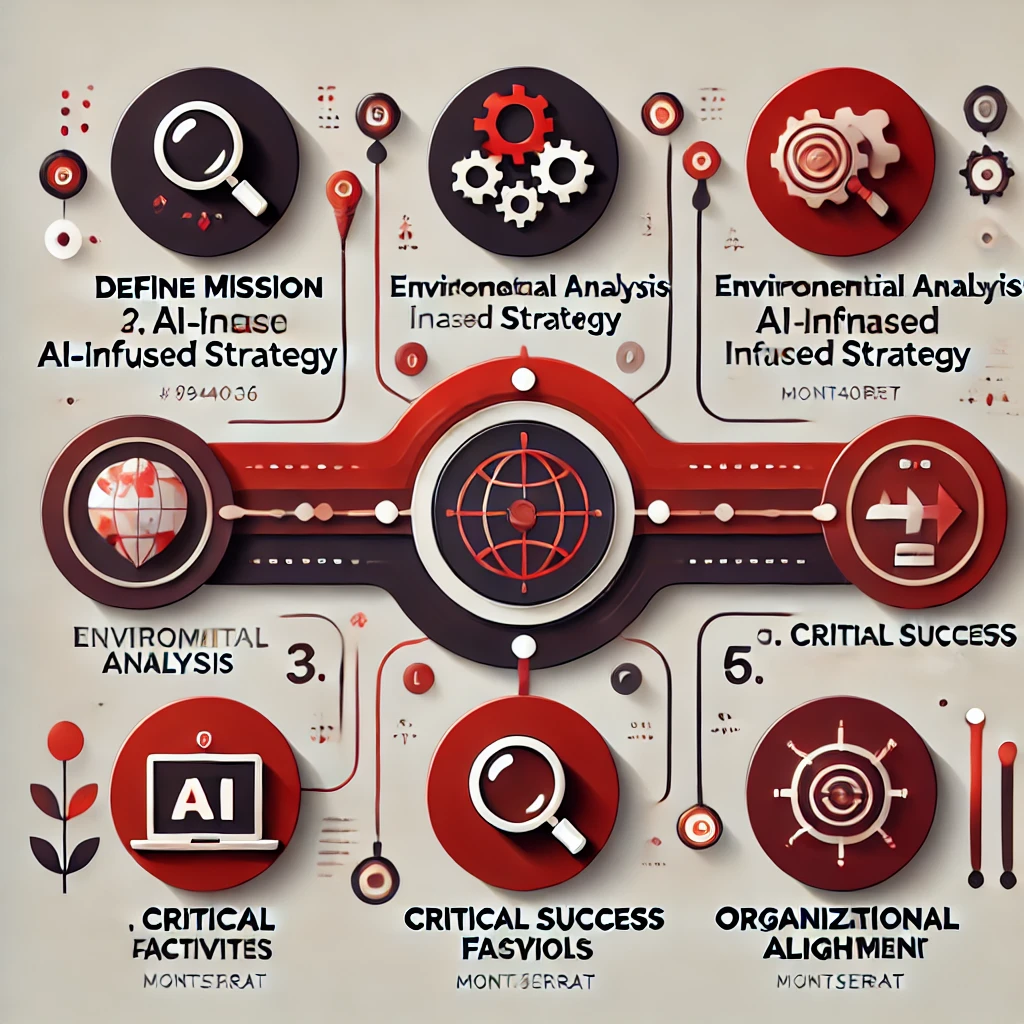
To systematically integrate AI into a broader business strategy, we can turn to the work of Professor Alexander Roberts, who developed the Making Strategies Work framework. This six-step system provides a structured approach for weaving AI into strategic initiatives:
- Define a Clear Mission - Ensure AI projects align with core business objectives—avoid chasing “shiny object” trends. - Example: If your mission is to become the most customer-centric retailer, focus AI on improving supply chain visibility or personalized recommendations.
- Analyze Your Environment - Evaluate market shifts, competitor moves, and regulatory changes (Key Environmental Indicators). - Internally, assess data readiness, skill sets, and potential cultural barriers. This is the time to map your organization’s AI maturity.
- Develop AI-Infused Strategies - Identify enablers (like strong data or a supportive executive champion) and barriers (such as silos or outdated processes). - Plan how AI will support strategic objectives—perhaps accelerating product development cycles or improving customer service response times.
- Identify Critical Success Factors (CSFs) - Focus on the must-get-right areas that will make or break your AI vision—like robust data governance, clear ethical guidelines, or well-defined change management efforts. - Example: A CSF might ensure real-time data feeds from weather satellites and airport operations for an airline that aims to minimize flight delays.
- Define Critical Activities (APIs) - Pinpoint specific tasks and assign ownership—who’s responsible for data cleaning, model training, or pilot deployment? - Set milestones and measurable targets, e.g., “Complete data training for 50% of frontline staff by Q2.”
- Align Structures, Systems, and Processes - Realign org charts to ensure cross-functional teams can collaborate effectively on AI projects. - Revise performance metrics to reflect AI-driven outcomes (e.g., how effectively are AI insights integrated into decision-making?).
4. Measuring Success: Look Beyond Traditional KPIs
AI’s value often goes beyond short-term metrics like revenue or cost savings. Leading organizations track three kinds of indicators:
- Key Environmental Indicators (KEIs): Market sentiment, competitor behavior, and evolving regulatory landscapes around AI.
- Key Performance Indicators (KPIs): Traditional metrics—revenue, profit, customer satisfaction—but continually assessed to detect longer-term AI benefits.
- Activity Performance Indicators (APIs) are task-oriented measures, such as the number of employees who have completed AI upskilling programs or whether data pipelines function securely and reliably.
Tip: Combining these metrics paints a more complete picture of AI’s impact—both internally and externally.
5. Putting It All Together: The Path to Sustainable Gains
By combining AI with process innovation, cultural evolution, and strategic alignment, organizations can unlock new possibilities:
- Personalized Products: Customized recommendations that adapt to user behavior in real-time.
- Predictive Services: Anticipating issues before they occur—like proactive maintenance for machinery or real-time fraud alerts.
- Smarter Decisions: Rapidly analyzing data sets too large for human processing, enabling evidence-based strategies at scale.
However, technology alone doesn’t deliver success. Ultimately, how we adapt our processes, retrain our teams, and align our entire organizational DNA determines if AI catalyzes lasting value. The journey often requires investing in the proper infrastructure, empowering talent, and embracing agility in the face of ongoing change.
Final Thoughts: Leading the AI Revolution
AI undeniably shapes the future of business. However, its most transformative power is released when leaders view it as a collaborative and creative tool—not just a means of cutting costs. By defining a clear mission, focusing on the right success factors, and measuring beyond traditional KPIs, your organization can crack the so-called “Productivity Paradox” and harness AI for long-term growth.
Ask Yourself:
- Are you investing sufficiently in technology and the people who will use it?
- Does your company culture support experimentation and rapid iteration?
- How can AI help you stand out in a crowded marketplace?
The time to act is now. Embrace AI’s potential to elevate human work, redefine how decisions are made, and catalyze sustainable success. If you’re prepared to integrate AI as a core strategic driver, your organization can step confidently into the future—smarter, faster, and more competitive than ever.