**A Non-profit’s Digital Transformation **

Listen to the Deep Dive of the whitepaper or CLICK HERE to read.
ABSTRACT
This paper outlines the journey of a non-profit organization’s digital transformation under thoughtful and ambitious leadership. It aims to provide the reader with an intimate view of the key principles of digital transformation in action by skillfully dissecting what the organization has done and what it is working on. The direction the organization is heading in.
The transformation was a response to legislative change in January 2019 and was accelerated in March 2020 by the COVID-19 pandemic. CINTA & Co. developed and supported the implementation of a digital transformation strategy towards a customer-centric organization that is more data-driven, harnesses the power of machine learning, capitalizes on the economy of bits, and enables the ecosystem in which it exists.
Significant emphasis has been placed on the fact that the effective design and use of digital tools and platforms result from the users’ mindsets and behaviours. The proposed system dictates that the organization asks its staff to be open-minded, agile, and committed to being on a continuum of learning about the customer and testing their newfound knowledge.
Complementary to this mindset and behaviour is applying a customer-focused design thinking methodology to develop various positioned offerings. Transforming the organization towards a Data-Driven Decision-making culture and leveraging digital technology is a challenging road that all recognize to enhance the relationship with students, expand reach, and improve satisfaction.
**Themes discussed in this article: **
The Organization: A concise description of the organization’s position and how it must compete in the marketplace.
Embracing Digital Transformation: a consideration of data-driven decision-making as the nexus of transformation.
Artificial Intelligence: a brief history and potential consequences for the organization
Platforms in a digital economy refer to potential opportunities available in the digital world.
The platform revolution: a description of a custom platform and the business concepts that underpin its success.
Harnessing the crowd, exploring the crowd (decentralized knowledge), and the core (centralized knowledge).
Exploring the limits to decentralization, what blockchain technology is, how it decouples centralization, and a description of potential applications.
TABLE OF CONTENTS
- THE ORGANIZATIONAL PROFILE
- THE BUSINESS CASE
- ABOUT THE TRANSFORMATION
- ARTIFICIAL INTELLIGENCE & MACHINE LEARNING - Since When?
- WHAT WOULD HAPPEN IF WE DON’T EMBRACE AI-FIRST
- HOW TO BENEFIT FROM EMBRACING AI & MACHINE LEARNING
- HARNESSING THE POWER OF FREE, INSTANT, & PERFECT TO CATALYZE GROWTH
- CONTENT STRATEGY - AMPLIFYING WITH COMPLIMENTS
- THE REBALANCING OF ONLINE & OFFLINE
- THE VALUE OF CROWD-RELATED TRANSFORMATION AND EFFECTS ON THE CORE
- LEVERAGING THE CROWD FOR INITIATIVE IDEAS
ORGANIZATIONAL PROFILE
Organization Name:
_* We take our clients’ confidentiality seriously. While we’ve changed their names, the events and results are real. _
**Industry: **
Education
Objective:
Achieve revenue stability and position for growth
Strategic Position:
The organization is a non-profit entity with a portfolio of products, services, and experiences for its members (students). The offerings fall within one of two categories of competitive positioning.
-
Access-Based – All offerings that are funded by mandatory fees. In theory, these services should be positioned as Cost Leaders to achieve an advantage.
-
Variety-Based - All offerings that are funded by optional fees. Here customer purchase decision is based on perceived price vs perceived value. In theory, these services should be positioned as differentiated to achieve an advantage.
Fit For Value Creation:
Providing products and services to enhance student’s academic experience
The Student Union faced two consecutive waves of disruption that threaten its very existence.
The immediate impacts of COVID 19 and as well the Student Choice Initiative (S C I ) can be summarized as follows:
- Virtual classes 2020/21; return date to campus is uncertain
- Increased financial insecurity amongst stakeholders
- Increase in mental health insecurity amongst stakeholders
- Impediment to the Student Unions current service delivery model(s)
- S C I legislation has forced many of the offerings to be funded by optional fees
We can reason to argue that the range of issues come down to two problem statements that we must solve:
-
What must the Student Union do to augment the people, places and things needed to effectively deliver on all category value propositions to multiple customer segments.
-
What must the Student Union do to create, communicate, and deliver value to specific student audiences in a manner that will drive satisfaction and enhance the relationship?
Considering our recent environmental scan, fundamental challenges in solving those problems exist within the current business model/practices. Below are four resistors that are of most consequence.
- Currently, rely on the core to decide what programming to execute without evidence to support decisions.
- The community (local market) comprises multiple niche groups that pay for value on a subscription basis.
- The organization has little to no insight on shifting tastes and preferences for each niche group or who belongs within each group.
- Subscription cycles are quarterly, and fees are due after the school year has already begun.
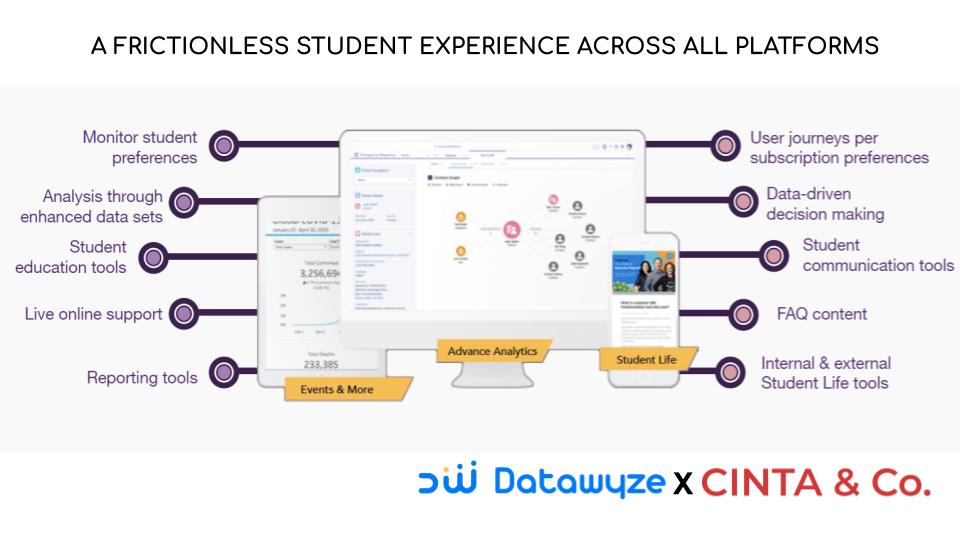
To achieve revenue stability and subsequent growth in this rapidly changing environment, we propose a scope and direction focused on leveraging data and insights to improve the product/ service offering(s) through operational excellence and product/service development.
“The more companies characterized themselves as data-driven, the better they performed on objective measures of financial and operational results. In particular, companies in the top third of their industry in the use of data-driven decision making were, on average, 5% more productive and 6% more profitable than their competitors” (Brynjolfsson and McAfee 2012).
Pricing and subscription management will be a crucial battleground. Knowing the customer and putting in front of them a specifically curated product is paramount. “Amazon estimates that 35% of its sales are from cross-selling activities such as recommending items” (Brynjolfsson and McAfee 2017, 47).
Below is a disaggregation of the big idea into its constituent parts:
- Shift behaviour (s) towards heavy data-driven decision making and invest in technology to better acquire data and efficiently turn it into insights
- Systematically investing in digital delivery platforms and direct communication tools.
- Planning and designing with a feedback loop of data that informs product development
- Designing to create better, communicate, and deliver content, programs, experiences/services focused at niche levels utilizing machine learning tools
- Adopt automation tools to reduce the operational cost of accessed based products
- Plan and design to be able to utilize 18-24 months of data (subscription, user feedback data) to begin to model and forecast subscription rates for category offerings by niche group profile
Conceptually one can describe this approach as harnessing the virtues of rapid digitization and rebalancing critical areas of the organization to become more adaptable and resilient as defined by our current times.
ABOUT THE TRANSFORMATION
The proposed scope and direction of the organization require a shift towards a customer-centric data-driven approach. Increased consumer choice and empowerment creates a paradigm threatening the funding of 65% of the Student Unions’ offerings. Rapidly changing tastes and preferences coupled with a shift in social patterns and behaviour accelerated by the pandemic requires an augmentation of the organization’s operations.
A significant amount of consideration must be given to the change to the organizational design and its change sequence. The ability to utilize digital technology is not anticipated as a resistor by the staff and management. However, clear preferences are communicated as individuals and groups utilize tools that fit their current practice(s) at their convenience, irrespective of whether they speak with the tools used by other teams or groups within the organization.
Effective design and use of digital tools and platforms are a consequence of the mindset and behaviours of the users; this is a key battleground. The proposed system dictates that the organization must ask its staff to think about answering the following questions.
- Who is the content/service/experience geared towards?
- What value are the target students going to get from this (category value proposition)?
- What things that are on their mind will we address?
- What perception/feelings do we want them to feel after consuming the content/service/experience?
They must also behave in a manner where they must:
- Demonstrate how they are leveraging data and insights
- Display how they are leveraging digital delivery platforms and one-to-one communication tools
- To begin to utilize the fourth quarter of the organization’s business cycle to plan and organize resources and test assumptions before the upcoming school year.
The need to drive value in short windows lends itself to redesigning the organization in a manner that requires existing management and staff to:
- Form multidisciplinary project teams (Break down silos)
- Effectively execute multiple short-run projects that run concurrently (Shift away from an inline production style)
- Deliver content / experience / programs / that meets the value expectations of the students based on evidence (shift to DDD)
- Perform with a high level of transparency and speed: (Decentralize authority)
Pivotal to mobilizing this mindset and behaviour is applying a customer-focused design thinking methodology to develop various positioned offerings, similar to what was introduced to the organization to create the 2020 Health & Wellness curriculum and initiatives calendar focused on mental health. For this particular exercise, we executed the following process:
- Engaged the crowd and incentivized students to participate in an online survey to quantify the range and depth of mental health challenges that exist in the market
- Conducted one-on-one interviews to gain a better understanding of the student(s) lived experience(s)
- Prioritized key problems and created personas based on the research data to humanize each of the problems
- Developed problem statements (How might we…) to solve problems we identified for each persona
- Executed a dynamic and interactive workshop with core team members to develop purposeful solutions to each personas challenges
- Designed curriculum/initiatives calendar to meet the needs of the personas over the school year
Achieving this transformation requires the management of talent gaps and shifting functional roles to gain full benefits. Transforming the organization towards a Data-Driven Decision-making culture and leveraging digital technology is a challenging road that will allow the organization to enhance its relationship with its students, expand reach, and improve satisfaction.
Change efforts focused on process and technology is easy to do, easy to measure, easy to point to. Perfect for bureaucracy, yet a Harvard Study says “internal leaders’ skills sets don’t match the needs during change – Disconnected” & “managerial capacity to implement it [Change] has been woefully underdeveloped.”
CINTA & Co. believes this is because the persons’ subjective reality is being missed in the whole conversation. Individuals need to have the resources, support, and the will to change!
On the journey of transformation, people experience three moments of truth:
- Process Change - Alignment, Perception, and Capabilities
- Respond to change - Victim or Agent
- Experience the Change - Attitude, Motivation, Resilience
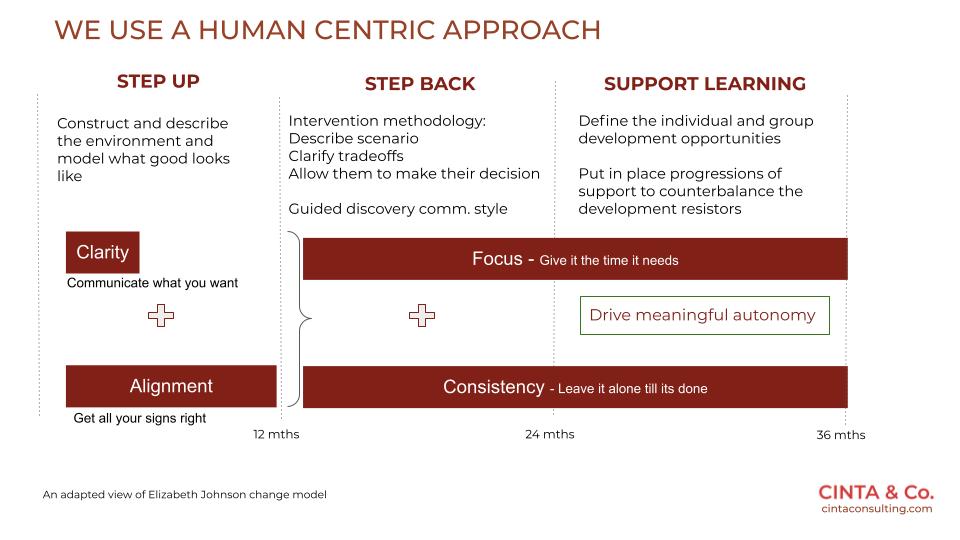
When working on these transformation projects, we often leverage the work presented by Dr. Elizasbeth Johnson. Essentially, she describes that you have to set up and step back as a firm leader! We affirm that you don’t step away!
**Meaning **
Step Up:
- Provide clarity - Why the change needed, why now, what will the outcome be etc.
- Create Alignment - What do you say when you meet them for coffee? What are they agitating for in meetings? Are you consistent in driving for the change? - What do you do? Are you role modelling the change you asked for? Are you making conscious efforts to participate in change? Are there times in your calendar each day dedicated to the change? Signalling to the team and open the door to discuss change? As an agent of change, is alignment being resourced: budget and human resources? Are you getting the right people to support the change? Measuring the change, setting KPI’s and metrics aligned to the new change
Step Back:
- Allow managers to focus on it; they need some slack to adjust. Leaders need to give it some time to take form.
- Display consistency in behaviour; leave it alone.
You step back, not away. Leverage a system by where you support:
- Developing Capabilities – Provide stakeholders with the transformation-related skills to manage any disruption or change
- Focus on Individuals – Treat people as humans who need unique support through the process.
- Support Leaders & Teams – Internal resources can not be expected to be change specialists; provide support with specialty resources/change guides as needed or required.
Time Out:
We will be using the Matrix of Change tool in multiple dimensions of this project. The tool is used to help understand how to manage the transition from one organizational plan to a new one. It brings understanding as to how new processes work together and how they work with the old system. Business processes have to _complement each other_; otherwise_, they won’t create a coherent system. Additionally, business processes must be complementary between existing and future sets_; otherwise_, the transition will be difficult. _
The Matrix of Change helps _to check whether processes are complementary or conflicting systematically. Using this tool helps the organization to map and manage digital business strategy transformations._
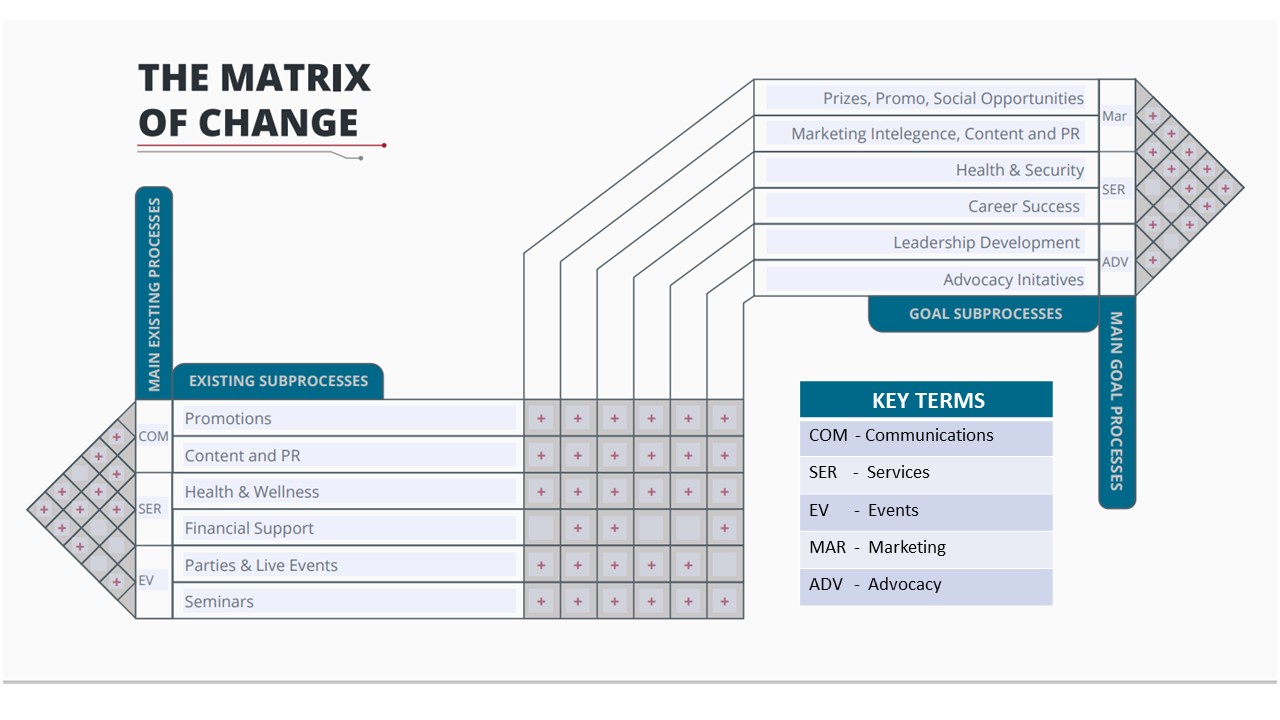
Figure 1
The matrix of change model describes the organization’s required structural changes to move towards a Data-Driven Decision-making paradigm effectively.
The organization will realize subscription and revenue benefits by delivering exceptional service and achieving differentiation by improving Customer Insight and Category Focus. By establishing a loyalty program, activating a customer life cycle model and leveraging data and analytics and redemption technologies, the Student Union will be allowed to become more relevant, recent and engaging with its customers. Furthermore, strong category management focused on operational excellence for essential services and refining optional fee offerings will create an experience consistent with a differentiated corporate and brand strategy.
- Investing in expanding reach by establishing mixed platform communications and producing new digital channel solutions
- Designing and executing a content calendar aligned to Wellness & Security, Career Success, Advocacy & Leadership curriculum/initiatives calendar as a means to amplify the value proposition of the respective categories
- Target communicating relevant content to student segments as defined by student profiles, and refining profiles through analysis of participation and consumption data
- Investing in improving the organizations’ data collection and insights generating abilities
Collectively, this will afford the organization to effectively enhance brand loyalty and contribute to 10% growth year over year.
ARTIFICIAL INTELLIGENCE & MACHINE LEARNING - Since When?
Four main paradigms affect the efficacy of artificial intelligence.
-
Moore’s Law
-
Amount of Data
-
Methodological Tinkering
-
System architecture
Information Technology scientists use Moore’s Law to describe the state of computing power required to achieve desired outcomes in the early days of AI exploration. In the pioneering days of AI, computing power was “low” but growing exponentially.
Lack of digitization and connectivity (the rapid transfer of information) left codification and manual inputs as the dominant methodology to manifest the vision of Artificial-intelligence. Time has proven that method to be futile. The futility of these efforts has been described by referencing “Polanyi’s paradox.”
Benefits were realized from breakthroughs in other fields of science, particularly in areas where different sciences, including the social sciences, converged; biology, physics, mathematics, engineering, and developmental psychology inspired and enabled different camps in tackling the challenge/opportunity of AI to take form. A camp of practitioners called “Connectionists” made huge strides by modelling their work off of the functioning of the human brain – taking a deep networking model approach and leveraging the power of connectivity in function and form to enable learning. Applying a developmental pedagogy like that which is exploited by the human brain. These two learning methods are described as Unsupervised learning, using game/goal-oriented parameters to find patterns. The other being Supervised learning, the machine learning task of learning a function that maps an input to an output based on example input-output pairs. It infers a function from labelled training data consisting of a set of training examples.
In Approx. 2010, we reached the back half of the chessboard concerning computing power and the rapid digitization of information expedited connectivity and the rapid prototyping of different ideas and approaches towards advancing the domain of AI.
WHAT WOULD HAPPEN IF WE DO NOT EMBRACE AI FIRST?
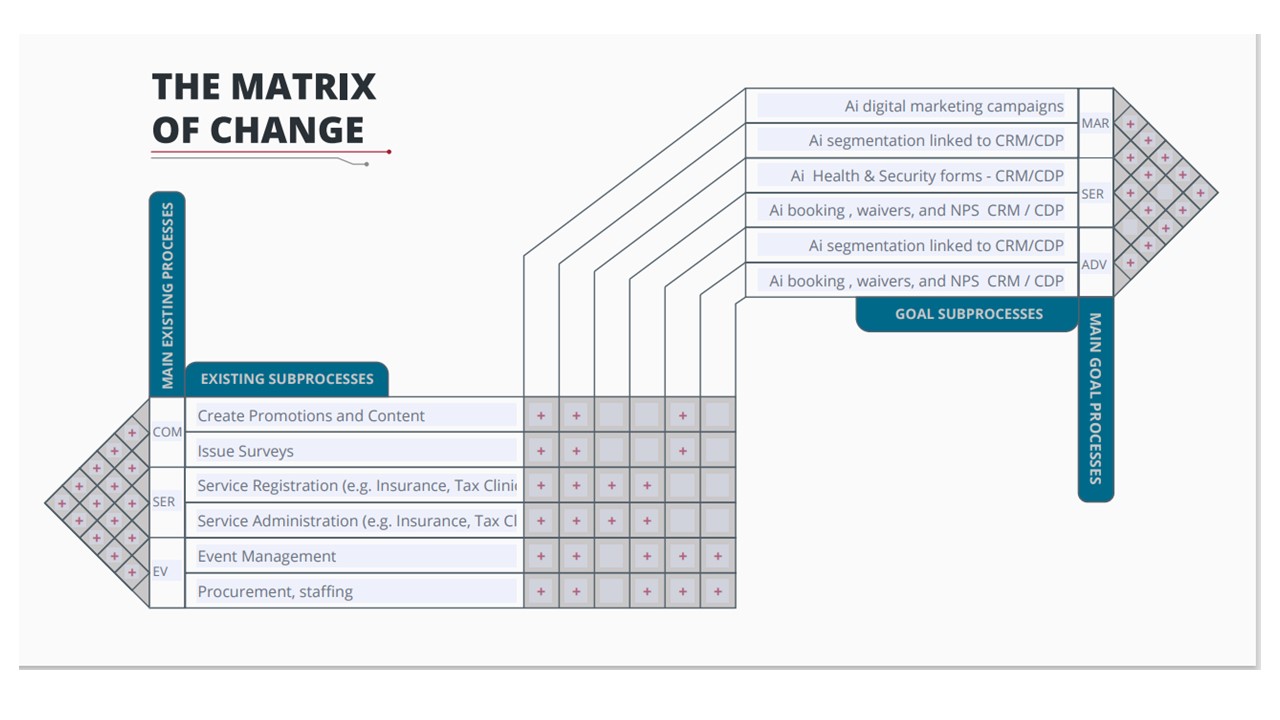
Figure 2 Matrix of Change model describing the changes required to adopt AI and Machine learning to support business functions.
Conceptually the Student Union provides value to students by providing complementary higher education services in a marketplace of 33,000 people.
The organization competes in multiple battlegrounds; It partners with and competes with the institution in itself. It also competes with outside service providers who target post-secondary students to provide products/services in Time management, Health & Wellness, Financial / Career Insecurity, and Leadership Development.
The organization’s current leverage is its connection with the students as the official representatives advocating and lobbying on their behalf. This leverage provides the Student Union initial access and a baseline of brand equity.
Throughout the student’s life-cycle, the organization competes for sustained or growth in the share of mind. It competes to maintain a share-of-wallet to advocate effectively and provide a reprieve from students’ self-identified pain points (time, money, health/mental health).
The Student Union is currently the barometer of success. Departments within the institution often copy its services or activities. If other departments & service providers can use machine learning, the Student Union will realize an erosion in competitive advantage and risk losing bargaining power when advocating for students.
HOW TO BENEFIT FROM EMBRACING AI & MACHINE LEARNING
The goal is to successfully navigate this rapidly changing environment and develop skill sets and tools that will allow the organization to be adaptable and resilient.
The organization will realize proof of meeting the goal through the achievement of healthy subscription rates and revenues. Evidence suggests that the Student Unions’ success factor is linked to achieving differentiation through improving Customer Insight and Category Focus.
By activating a Customer Life Cycle Model, utilizing unsupervised machine learning tools for customer segmentation. As well as supervised machine learning for product and service recommendations and targeted digital marketing campaigns, the Student Union can capitalize on the opportunity to become more relevant, recent and engaging with its customers.
Furthermore, strong category management and supervised machine learning tools for process automation will drive operational excellence for access-based offerings (essential services) and create an experience consistent with a differentiated corporate and brand strategy.
Specifically, it will allow the Student Union to:
- Target communicate relevant content to student segments as defined by student profiles and refine profiles through analysis of participation and consumption data
- Inform the design of the Wellness & Security, Career Success, Leadership & Advocacy curriculum and initiatives calendar
- Develop a recommendation tool as a passive sales agent
- Collectively this will afford the organization to enhance brand loyalty effectively and contribute to a target of 10% growth year over year
**HARNESSING THE POWER OF FREE, INSTANT, & PERFECT **
TO CATALYZE GROWTH
Discovering how to catalyze growth effectively can be done by exploring two domains.
Complements: What products are complementary to your current products (or your industry’s products)? Can the organization offer digital goods that entice people to buy a physical product?
Network effects: How can some customers’ purchase and use of your business’s products improve the value that other customers gain from the product? How might customers gain value by connecting? Would data about product use enable improvements in product performance and customers’ full use of your product?
With effective execution of the below digital marketing & communication success factors, the organization will enhance its relationship with its students, expand reach, and improve satisfaction.
- Invest in expanding reach by establishing mixed platform communications and producing new digital channel solutions.
- Design and execute a content calendar aligned to Wellness & Security, Leadership & Advocacy, and Career Success curriculum/initiatives calendar as a means to amplify the value proposition of the respective categories.
- Target communicating relevant content to student segments as defined by student profiles, and refine profiles through analysis of participation and consumption data.
- Invest in improving the data collection process and insights generating capabilities.
Furthermore, it will support the positioning of the Student Union as a point of intersection, enabling the community of students to unleash their voices and their potential on the world. The aforementioned tasks will increase engagement of relevant segments and drive conversions (successful sale of product or service) when the organizations’ online media integrates with its offline dialogue in a repeatable and relevant manner. Evidence suggests that the best results occur when dynamic dialogue is reinforced further with experiential marketing efforts.
The Student Union ought to seize the opportunity to enrich existing offerings and leverage the rich capabilities of digital platforms.
Specifically, develop a FREE platform that broadcasts the Student Union’s branded celebrity-hosted events, Point Union content, and other relevant content.
Point Union is a virtual, interactive show that serves as complementary content when a content calendar is designed and executed in alignment with Wellness & Security, Leadership & Advocacy, and Career Success curriculum/initiatives calendar.
Content and events related to mandatory fees will be free, and all students will gain limited access to subscription-based content and events. Students subscribed to a particular category offering will gain access to a digital archive of all category relevant content and events and acquire enhanced benefits and experiences.
Doing so will amplify the value proposition of the respective categories and enrich the overall student experience.
Providing category-related subscribers with the opportunity to engage in chat or Q&A during live streams. As well as the encouragement of interactions amongst all viewers and participants can bring about network effects. the Student Union can broadcast live streams across multiple platforms, e.g., Instagram, Facebook, YouTube, Snapchat.
There is also the opportunity to leverage the economic properties of digital assets and repurpose them in various ways to exist on multiple platforms [Instagram, Facebook, YouTube, SnapChat] once they have originally run through the Student Unions platform (website). Promoting the segments on various platforms through organic and paid efforts will allow the organization to reach many students.
The organization ought to capitalize on the economics of free, perfect, and instant goods and look to inform the product development process by uncovering new products or services to be offered. And/or to inform changes to practices and processes to take advantage of the features of the digital economy.
CONTENT STRATEGY - AMPLIFYING WITH COMPLIMENTS
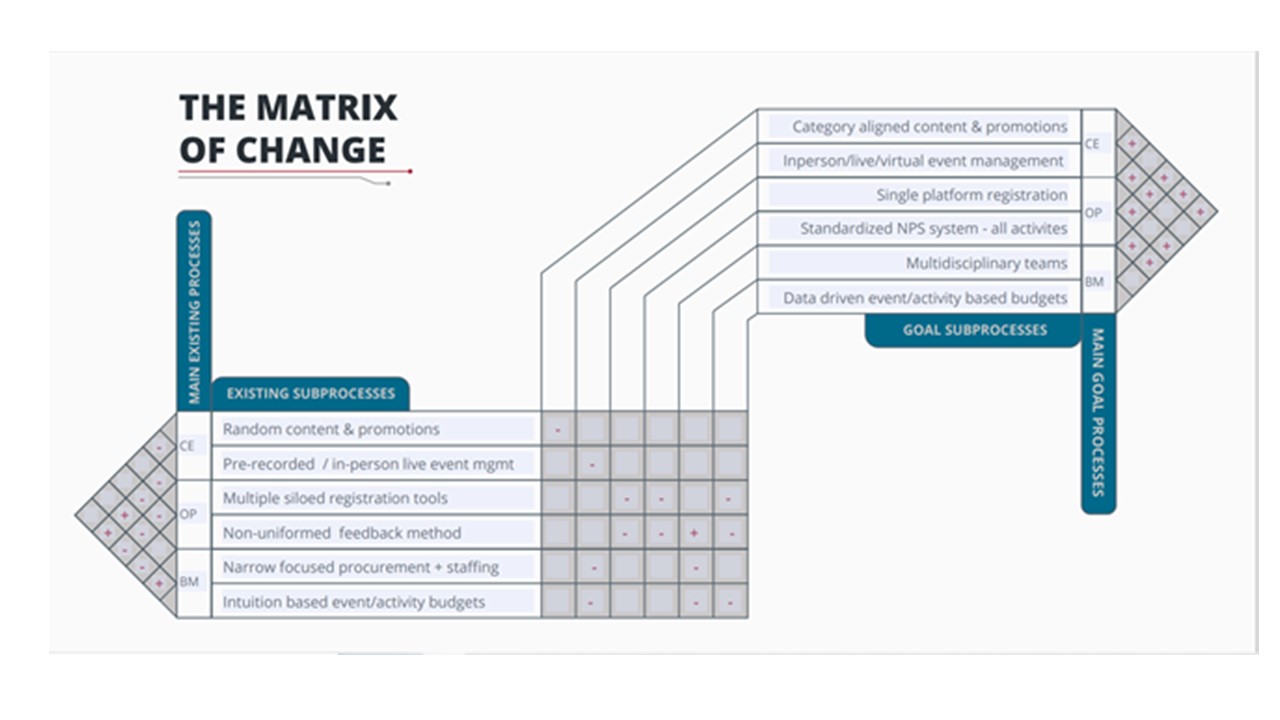
Figure 3 This matrix of change depicts the content development process change required to achieve amplification.
An interactive platform providing complementary content related to mandatory fees completely free of charge and with limited free access to subscription-based content, with enhanced features and benefits to subscribers, will amplify the value proposition of the respective categories and enrich the overall student experience.
Machine learning and AI will be advantageous to develop and execute a relevancy-based communication process that uses the customers’ lifecycle position and service/product offering as co-variables. This approach will enable the development of a communication calendar that proactively engages subscribers’ (and prospects) with relevant content, products and service promotions, as well as relevant events and workshops and an NPS (Net Promoter Score) feedback loop.
The 2019/20 customer participation analysis shows that not all offerings are relevant to all students. There are large amounts of customer segments who do not receive the value that is intended for them. For example, the demographic profile of the Student Unions’ 2019 LinkedIn Local event participants is consistent with the Machine Learning predictions.
- Age group 23-27
- Faculty of Business 47.5% & Faculty of Media 22.1% students made up the largest share of participants
- Female students represented 56%
- Participants who attended that opted into 1 fee only – 91% was future skills fee, the other 9% was Leadership
- Participants who opted into 2 fees only – 57% opted into financial security, and 43% opted into Future Skills Development
350 people of a potential market fitting the same demographic characteristics of approximately 3,650 others registered for this event, and 135 of those people participated.
In other words, 91.5% of the potential market was unaware or unprepared/uninterested in receiving the value offered at said time, date, and location. 59% of the people who indicated they wanted to receive the value offered at said time, date, and location did not consume it.
That presents serious implications when accounting for the organization’s costs to serve and how subscribers value the organizations’ offerings.
The opportunity at hand shifts the demand curve by increasing access to value-generating activities by adopting a digital platform. When analyzing the audience, the organization must think beyond paying with their money and considering how they pay with their time. Many students commute to campus with a travel time of (=/+)1 hrs each way. Many have part-time jobs not located close to campus.
Time, Income, and concerns around mental health have been reported as the largest customer pain points. Leveraging digital platforms and providing free, instant and perfect access to offerings will shift the demand curve to the right.
THE REBALANCING OF ONLINE & OFFLINE
The evolution of customer and consumer expectations warrants adaptation to becoming a service provider offering Online to Offline solutions. The intent is to pursue effective action to allow the organization to provide customized, timely, relevant content, workshops, resources, and access to essential services.
Furthermore, it will support the positioning of the Student Union as a point of intersection, enabling our community of students to unleash their voices and their potential on the world.
The mission (to support our students in getting the most value out of their educational experience and supporting their growth as a person to prepare them for life after College / University effectively) is met with the difficult reality of a highly segmented audience concerning tastes and preferences and aesthetics. Ultimately rendering current generic engagement strategies insufficient. Fortunately, current insights inform us that the current UX focus and value propositions of existing category offerings are well aligned to address students’ pain points.
The environmental scan shows that these customer pain points are localized to three main clusters – Time, Money, Stress and Anxiety. Currently, offerings are structured as a portfolio of products across four main categories (health and wellness, Advocacy & Leadership, Career Success and Financial Security, and Social Opportunities), some being competitively positioned as Access Based (paid by mandatory fees) and others as Variety Based (Purchase decision is based on perceived price vs perceived value).
This digital revolution has rushed consumers to adopt and/or expect platform-enabled products that provide value by solving a pain point in a highly customizable manner and relevant to them as individuals. The development of a FREE to use platform provides students with curating products, services, contests/promotions, and experiences relevant to the individual. Acts as the main channel that live streams AGMs, The Student Union branded celebrity-hosted events, Point Union content. Any other relevant content enhances the academic experience.
- Content/resources/events related to mandatory fees will be free for all customers. All students will gain free access to short-form content to all category offerings and limited access to subscription-based resources/events.
- All students will gain access to base-tier promotions and contests.
Students subscribed to a particular category offering:
- Will gain access to a digital archive of all category relevant content/resources/events
- Gain full access and be able to engage (more than view) in category-related live online events.
- Gain free (or highly subsidized) access to category related events/workshops/activities/resources online or offline (non-subscriber pays per engagement)
- Gains access to tier one prizes for category-related promotions and contests. (non-subscribers gain access to tier 2 prizes)
The data gained from this platform model will inform how to improve the offerings in each category and optimize pricing.
**THE VALUE OF CROWD RELATED TRANSFORMATION **
AND EFFECTS ON THE CORE
The success we are keen to measure is engagement. How many are engaged? Who is engaged? How are they engaged? When and where are they engaging? And ultimately, the covariable for all is why will they or why will they not engage?
All this serves as a proxy to validate or make apparent the success or lack thereof in creating, communicating and delivering value to the audience. Implicit in this exercise is that the first cause in a causal chain from idea to execution; that impacts the efficacy of this exercise is linked to the amount and quality of knowledge that we have of the target audience.
To optimally create, communicate, and deliver value, we must know what value, for whom, where, when, and how. Traditionally and rightfully, we put our faith in our core team of experts groomed or hired to solve this problem. By nature, the core team of individual experts can provide knowledge and insight into the current state of their particular domain. However, the marketplace and array of tastes and preferences are not static; it is ever-changing. The opportunities and risks associated with the 4th industrial revolution motivate and allow access to the crowd for expertise and insights across virtually all knowledge domains. Accessing the crowd and taking on recombinant approaches provides the opportunity to efficiently innovate/create value in an ever-changing landscape.
The seemingly impossible task of knowing where on the spectrum of value creation and delivery the organization should invest resources can be best answered by the crowd. The marketplace itself can tell us what to create and how to entice customers/consumers. The creative/innovation process is the recombination of variables to produce a desired or attractive output. The Student Union can fuel the creative process by exploiting three key factors of the crowd:
-
Scale - the sheer volume of contributor
-
The crowd is always evolving and recombining ideas itself
-
Allows the avoidance of dominant paradigms when tackling a problem
It is important to manage the perceptions of the core to ensure that they understand the opportunity and believe that the crowd will supersede their power and authority as domain experts to decide and create.
The Student Union can attain two highly beneficial outcomes by engaging the crowd for the creative process; Idea generation and Idea selection. As leadership designs activities and measurements to develop the team’s skills and capabilities, it should support their development in two areas of consequence.
- The adopting of a perception that engaging the crowd by way of contests can support collaborative innovation.
- Adopting the perception that the organization can apply open innovation to solve a broad spectrum of problems.
Fortunately, the Student Union has much experience, albeit with limited tools for sourcing solutions from the crowd, such as the 2018/19 student handbook cover design contest.
LEVERAGING THE CROWD FOR INITIATIVE IDEAS
The student union looks to mobilize its Equity Diversity and Inclusion mandate and operationalize its Anti-Black Racism playbook. It can look to the greater community for direction on execution.
To date, the student union has organized a core of domain experts, including E D I consultants, to support in achieving the following:
- Identify and understand the systems of power and privilege that currently exist.
- Challenge status quo by naming systemic inequities, racist policies and practices
- Develop strategies that recognize differences, promote the sharing of power and reward authentic collaboration.
Their action plan has defined desired outcomes, success factors, and critical activities and targets. The actual task or instrument for change still needs to be defined.
For example:
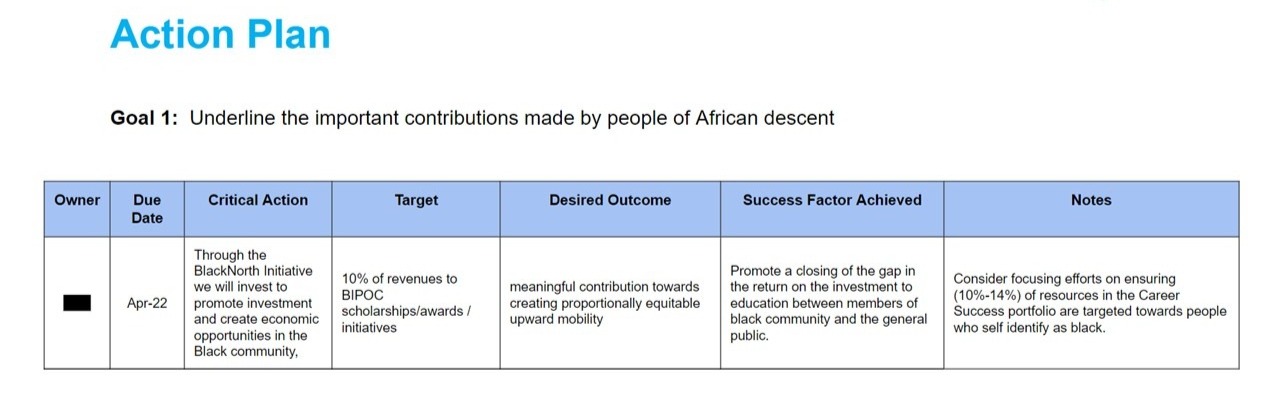
Figure 4: Anti-Black Racism Playbook 2020/21 Action Item
The opportunity exists to allow community members to submit proposals that aim to promote closing the gap in the return on the investment to education between members of the black community and the general public.
Ideally, solutions presented by the crowd will include but are not limited to creative activities, educational projects, speaker/lecture series, research activities, curriculum initiatives.
One can argue that because this challenge is funded with student dollars, submissions should be limited to the current college/university community (faculty, staff, student) and from academic departments or administrative units. One should note that by doing so, the organization severely limits the benefits that they can derive from accessing the crowd, scope and quantity of potentially good ideas.
A clear definition of outcomes is essential. For example, the selection team, a curation of core experts, potentially in collaboration with the crowd, must be guided by key factors similar to below:
- The solution aligns with the Union Student & College/Universities Code of Ethics, the Student Unions Advocacy and Leadership plan, and the student Anti-Black Racism playbook.
- The solution can be scaled and replicated for potential greater wide impact
- The solution addresses resource requirements, budget plan and financial sustainability
- The solution includes a plan to measure the impact
The organization can use machine learning to support the process by providing participants with good information and direction. By leveraging a Customer Data Platform that creates a persistent, unified customer database accessible to other systems of integrations to create attributes based on calculating data from user behaviour. As well as utilizing a Business Intelligence Solution to convert raw data into a meaningful narrative.
Utilizing these tools to provide profiles and personas in the local market specifically related to tastes, preferences, and consumer insights can provide a basic working knowledge of the college community that the crowd can stand their solutions on top of.
Segment, a CDP, can evaluate the proposed solutions and model the potential affinity for the solution across customer segments.
CONCLUSION
Throughout the student’s life-cycle, the organization competes for sustained or growth in the share of mind. It competes to maintain a share-of-wallet to advocate effectively and provide a reprieve from students’ self-identified pain points (time, money, health/mental health).
The goal is to successfully navigate this rapidly changing environment and develop skill sets and tools that will allow the organization to be adaptable and resilient.
The transformation at hand is becoming a hyper customer-centric organization that is more data-driven, harnesses the power of machine learning, and capitalizes on the economy of bits to enable the ecosystem in which it exists.
The good news is that the leadership of the Student Union knows that the real work to become counted amongst the 10-15% who are successful at the digital transformation; is in transforming the mindset and behaviours of the team.
References:
Big Data: The Management Revolution. https://hbr.org/2012/10/big-data-the-management-revolution
Renewed partnerships to monitor the state of local .... https://www.uclg.org/en/media/news/renewed-partnerships-monitor-state-local-democracy-and-achieve-sdgs-heart-uclg-executive